

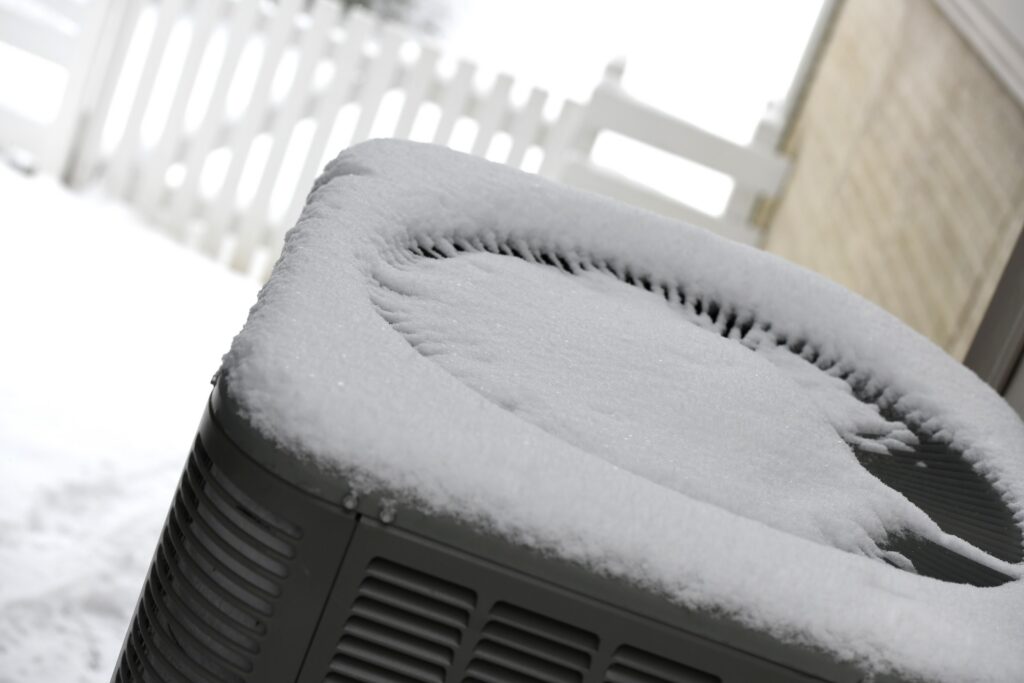
It’s normal to see a small amount of frost or ice on your heat pump in winter. In cold, humid conditions, frost naturally forms on the coil and refrigerant lines because the refrigerant flowing through them is so cold. However, too much ice buildup prevents a heat pump from continuing to heat, which is why the defrost cycle runs periodically to melt the ice. You need to be concerned if your heat pump is frozen solid with ice fully covering the coil, fan and base of the appliance. This issue can result in significant damage or possibly force you to replace your heat pump, so it’s something you always need to watch out for.
How the Defrost Cycle Should Work
Modern heat pumps have sensors that monitor the internal temperature and signal the defrost cycle to run. When defrosting, a heat pump temporarily reverses its cycle so that the refrigerant flows through the outdoor coil to melt the frost and ice. The defrost cycle normally only lasts for five to 15 minutes before the heat pump switches back to normal heating mode.
If the sensors fail or there’s an issue with the control board that prevents the defrost cycle from running, ice will continually build up. This eventually chokes off the appliance to the point where air can no longer flow through it.
The Mechanical Danger of Ice Accumulation
The biggest concern if the heat pump defrost cycle is not working is that the ice buildup can lead to costly damage. Heavy ice has the potential to warp or bend the fan blades, interfering with the fan’s ability to spin. Ice can also crush the copper refrigerant lines or delicate aluminum fins on the coil. Bent fins greatly reduce a heat pump’s effectiveness, while a damaged copper line can lead to a refrigerant leak.
If the issue is left unchecked and the heat pump continues to run after ice has choked it, the compressor may eventually fail. Replacing a failed compressor often costs several thousand dollars, which is why many people who have one opt to replace the entire heat pump.
If your heat pump is frozen solid, the other worry is that your HVAC system will run in auxiliary or emergency heat mode indefinitely. Cold-climate heat pump systems have electric heat strips mounted within the indoor air handler. These provide auxiliary heat as needed, such as if the heat pump isn’t heating, or it’s too cold outside for it to run. These heat strips consume far more electricity than the heat pump and will cause your energy bill to skyrocket if they’re on for too long. You can tell if your heat pump is in emergency heat mode by checking the thermostat.
Wisconsin Weather Culprits: Snow and Gutters
Cold, snowy Rhinelander winters present various challenges that can cause a heat pump to freeze solid. One thing to watch out for is overflowing gutters dripping water onto the heat pump. Gutters usually overflow because they’re clogged with leaves and debris, which is why it’s important to clean them in the fall. You can also keep water from dripping into your heat pump and causing it to freeze by installing an awning on the wall several feet above the appliance.
A heat pump can also quickly freeze if snow has drifted up around it and is blocking off the airflow. This latter issue is why HVAC professionals recommend using a heat pump stand to raise the unit so that it’s above the snowline. If your heat pump sits on the ground instead of on a stand, you need to continually clear snow away from it. During major snowstorms, you’ll need to keep shoveling around your heat pump overnight to prevent snow from causing it to freeze.
Professional Defrosting: What NOT to Do
When your heat pump is frozen solid, it can be tempting to use something like a screwdriver, hammer or ice pick to remove the ice. This is a bad move due to the risk of puncturing the coil or one of the refrigerant lines. If your heat pump is frozen, you’ll need to have a professional technician inspect it to determine what is preventing it from defrosting. As we said earlier, this issue is usually related to the control board or the temperature sensors. However, it’s also possible that the reversing valve failed or is stuck, or that the system is leaking and low on refrigerant.
Seeing more than a thin layer of frost is always a sign that your heat pump is in trouble and at risk of experiencing major damage. In this situation, you need to immediately call an experienced, local HVAC professional. When heat pump issues arise, you can always count on Frasier’s Plumbing, Heating, Cooling & Electrical for prompt, reliable service. We’ve been in business for over 100 years, and our team can handle any type of heat pump repair. We’re also the trusted source for winter HVAC maintenance in Rhinelander. Our team works on all makes and models and is ready to help you overcome whatever problem your heat pump has.
To schedule heat pump repairs before ice causes permanent damage, contact the experts at Frasier’s Plumbing, Heating, Cooling & Electrical.
FAQ
Is it normal to see steam coming off my heat pump?
Yes. Steam is a sign that the heat pump is currently defrosting. The steam is just a result of some of the moisture on the coil getting hot enough to evaporate.
Can I pour hot water on my heat pump to melt ice?
This generally isn’t recommended. While hot water will temporarily melt the ice, the water can quickly refreeze and lead to even more ice forming.
Why is my heat pump fan not spinning?
The fan always shuts off when a heat pump switches to defrost mode. If the defrost cycle isn’t running, and the fan isn’t spinning, ice could be obstructing the blades. It’s also possible that the fan motor has failed.